
News
Google starts connecting apps directly to AI Mode in Search
Google is rolling out connected-app actions in AI Mode, letting U.S. users link services such as Instacart, Canva and YouTube Music without rebuilding a task from scratch.
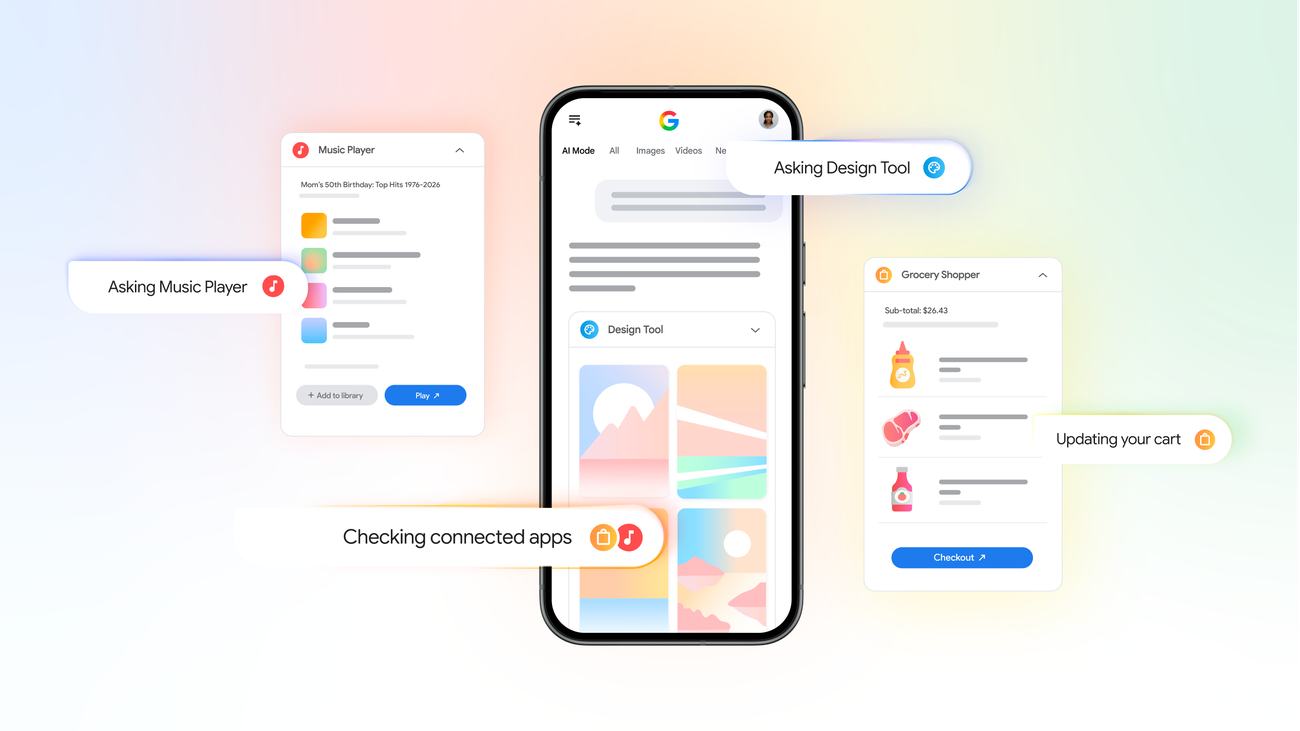
Google is beginning to connect third-party apps directly to AI Mode in Search, turning a search session into a place where people can start actions instead of simply reading links. In an announcement dated July 16, the company said the rollout was starting that week in the United States, with integrations for selected services including Instacart, Canva and YouTube Music.
The change is easy to miss among the larger promises around AI search, but it has a practical consequence for phone users: the answer page can become a bridge into the apps they already use. Google’s examples cover shopping, design and music, three everyday tasks that normally involve copying information from Search and then opening another service.
Three apps, three different jobs
Google’s announcement describes a limited starting set rather than a universal app layer. Its examples show how the links are meant to work:
Instacart: someone planning a barbecue can ask AI Mode for help with a grocery list, connect Instacart and send ingredients into a shopping cart. Google says checkout still takes place with a few taps in the Instacart app or on its website.
Canva: a user working on a flyer or another project can ask for design concepts and have Canva show relevant template options.
YouTube Music: AI Mode can help curate a playlist, save it to YouTube Music and start playback.
These are not identical forms of automation. The Instacart example moves information into a cart, the Canva example surfaces choices, and the YouTube Music example creates a listening destination. In each case, the useful part is the handoff: the user can move from an intent expressed in Search to a connected service without rebuilding the task from scratch.
What Google has actually announced
The wording matters. Google says users will be able to “securely link and interact” with some services inside AI Mode, but the announcement does not set out a single permission screen, a technical standard or a global launch timetable. It also does not say that every app can be connected, or that every example is available in every country.
For now, the firm’s confirmed scope is a U.S. rollout beginning in the week of the announcement. Google says it is working with more partners and expects to launch additional apps, but it has not published a complete future list. Availability can therefore differ between two people even if they use the same phone: the relevant factor is access to AI Mode and the supported service, not just the presence of an app in an Android or iPhone app drawer.
That distinction is important for anyone expecting a broad mobile release. This is a Search feature, not a new operating system or a replacement for the connected apps themselves. Google’s own examples keep the final interaction in the partner service where appropriate. A grocery purchase is not completed by a chatbot alone, and a playlist is still saved to YouTube Music.
Why this matters on a smartphone
Mobile users have long dealt with the friction of switching between Search, notes, shopping apps and media services. App links reduced some of that friction, but they still left the user responsible for carrying the context across. Google’s new approach aims to make Search more useful as a starting point for a multi-step task.
The benefit will depend on how well the integrations preserve user control. A helpful handoff should make it clear which account is connected, which app will receive information and when the user is leaving Search to review or confirm an action. Google describes the connections as secure, but its announcement does not provide enough detail to judge every permission or data-flow question. Users should still check the destination service, cart contents, playlist and account before confirming anything.
There is also a clear limit to what can be inferred from the announcement. Google has not published independent performance results, adoption figures or a promise that the feature will work with all apps. This is an early product rollout, not evidence that Search can reliably complete every task on a user’s behalf.
The next test is coverage
The initial examples are familiar, but the long-term value will be decided by breadth and consistency. More partner apps could make AI Mode useful for travel planning, events, productivity or communications, while a narrow catalogue would leave it as a convenience for a few specific workflows. Google says more integrations are coming; it has not yet given dates or a full partner roadmap.
For users in the United States, the practical next step is simply to look for connected-app options in AI Mode and verify what each service is asking to link. For everyone else, the announcement is a signal of Google’s direction rather than a confirmed local release. Search is moving closer to the apps around it, but the rollout is still selective, regional and dependent on the services Google has connected.
Source: Google’s official announcement on connected apps in Search.