
News
Qualcomm’s Snapdragon Reality Elite targets AI-ready Android XR devices
Qualcomm has announced a new XR platform built for on-device generative AI, higher-resolution mixed reality and more efficient headsets and smart glasses.
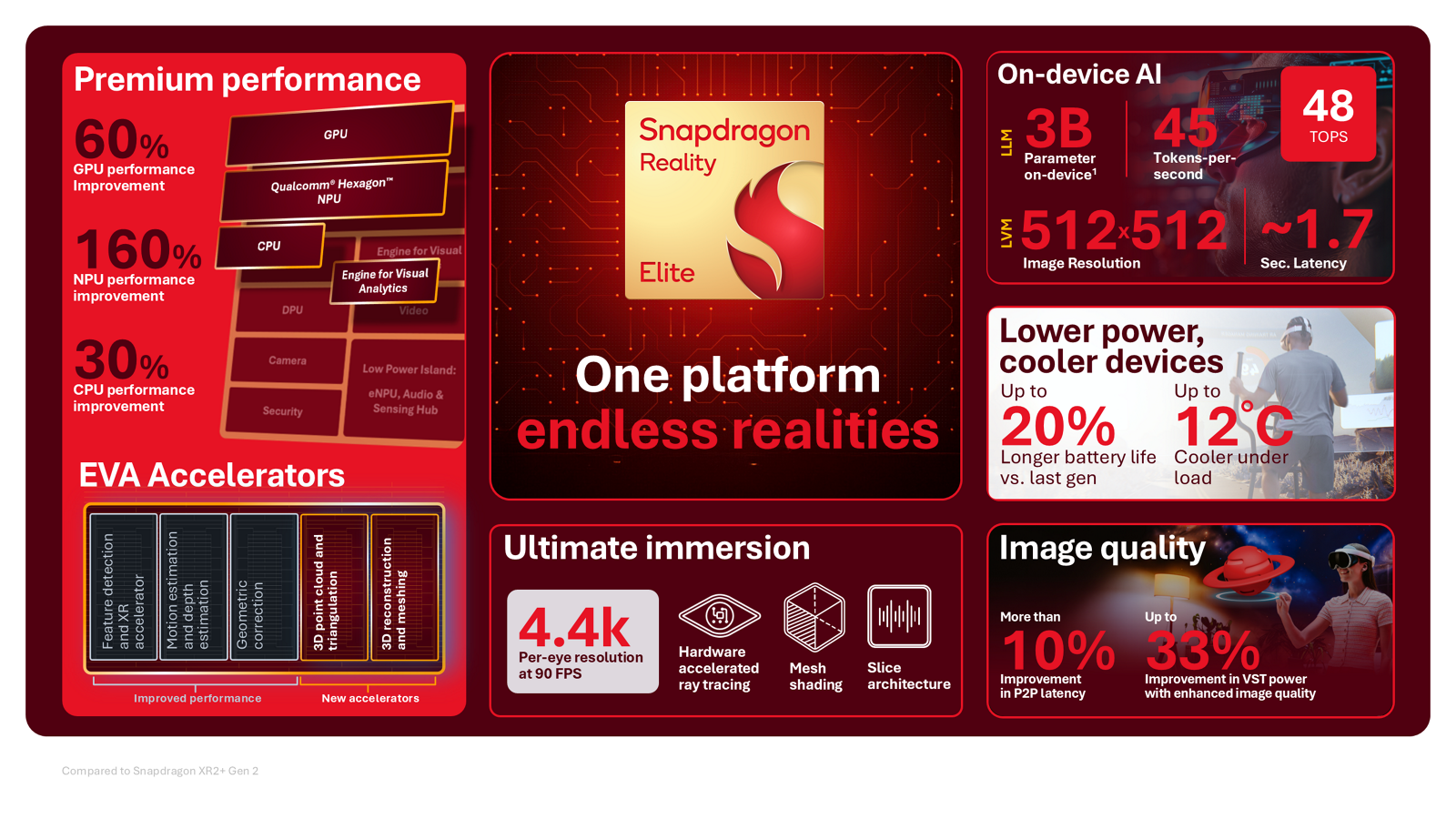
Qualcomm is positioning its new Snapdragon Reality Elite platform as a foundation for the next generation of Android XR headsets and intelligent glasses. Announced on June 16, 2026, at Augmented World Expo, the platform combines higher graphics performance with on-device generative AI and a more flexible design for different types of spatial-computing hardware.
The announcement matters beyond the headset market because it shows how smartphone-style processing is moving into devices that sit between mobile computing, apps and telecommunications. Qualcomm says Snapdragon Reality Elite is designed for both all-in-one video-see-through headsets and tethered optical-see-through devices. That means manufacturers can use the same platform family for products that place a fully rendered digital scene in front of the user and for lighter glasses that overlay information on the real world.
At the centre of the platform is its local AI capability. Qualcomm says Snapdragon Reality Elite can deliver up to 48 trillion operations per second, or TOPS, for artificial-intelligence workloads. The company says the platform can run large language models and large vision models directly on the device. In practical terms, that gives developers a hardware base for spatial agents, context-aware interfaces and computer-vision features that need to respond inside the headset rather than sending every step to a remote server.
Qualcomm’s examples are deliberately broad. The company describes possible experiences including photorealistic avatars, language-model agents and real-time generation of objects inside a user’s environment. Those are platform capabilities rather than a list of finished consumer applications, and the final experience will depend on how manufacturers and software developers implement them. Still, the direction is clear: XR devices are being designed to interpret their surroundings and respond locally, with AI treated as part of the core architecture rather than an optional cloud service.
On the graphics side, Qualcomm claims up to a 60% increase in GPU performance, up to 30% higher CPU performance and up to 160% higher NPU performance compared with the previous Snapdragon XR2+ Gen 2 platform. The company also lists support for displays up to 4.4K per eye at 90 frames per second. That combination is intended to make mixed-reality scenes look sharper and feel smoother while leaving developers more processing headroom for tracking, rendering and AI at the same time.
Power efficiency is another part of the announcement. Qualcomm says the platform can provide up to 20% longer battery life at the same workload and run up to 12 degrees Celsius cooler under load than the previous generation. These are Qualcomm’s own comparison figures, not independent test results. The company’s product brief also notes that results will vary according to the device design, settings and implementation chosen by each original equipment manufacturer.
The architecture is designed to support several ways of building an XR product. Snapdragon Reality Elite can be used in all-in-one systems, as well as tethered optical-see-through and video-see-through designs. Qualcomm says this flexibility should give manufacturers more freedom to trade off weight, battery capacity, display hardware and processing location. A lighter pair of glasses may use a different arrangement from a self-contained headset, even though both can draw on the same platform family.
Connectivity remains important in that equation. Qualcomm’s product brief lists the FastConnect 7800 Mobile Connectivity System, Wi-Fi 7 support with a peak speed of 5.8 Gbps and Bluetooth 6.0. These specifications do not guarantee a particular real-world experience: network conditions, accessory design and regional support will all matter. They do show that the platform is intended to work as part of a broader personal-device ecosystem, where XR hardware can communicate with phones, computers and other connected accessories.
The first announced products are still ahead rather than available for purchase. Qualcomm says Snapdragon Reality Elite will power XREAL Project Aura, which is expected to launch later this year, and will also be used in an upcoming device from Play for Dream. The announcement does not provide consumer pricing or a broad retail availability schedule for either product. Those details will need to come from the device makers.
Qualcomm’s official announcement presents Reality Elite as a platform for more immersive and intelligent XR, while the company’s product page sets out the published performance targets and supported form factors. For developers, the important takeaway is not a single finished feature but the combination of local AI, higher visual throughput and connectivity in a chip intended for multiple device categories. For consumers, the more cautious conclusion is that the hardware groundwork is being laid now, while the quality, comfort and usefulness of the eventual experiences will depend on the products built around it.