
News
Samsung’s Galaxy Z Fold8 launch links foldables to a wider AI platform
Samsung’s July 22 announcement connects three new foldables with Galaxy AI, watches and intelligent eyewear while adding more visible privacy controls.
By Amelia Santos
Samsung used its July 22 Unpacked event to present the Galaxy Z Fold8 Ultra, Galaxy Z Fold8 and Galaxy Z Flip8 as more than three separate foldable phones. The company’s announcement places the new devices inside a broader system of AI features, watches and intelligent eyewear. It is a familiar direction for the mobile industry, but this launch makes the shift unusually explicit: the phone is being positioned as the place where personal data, connected actions and device-to-device context meet.
The three models target different use cases. Samsung describes the Fold8 Ultra as its productivity-focused flagship, the Fold8 as a larger-screen device for reading, viewing and gaming, and the Flip8 as a compact phone built around quick interactions and self-expression. The Fold8 is listed at 201 grams with a 4,800 mAh battery, while the Fold8 Ultra has an 8-inch main display, a 5,000 mAh battery and a listed unfolded thickness of 4.1 mm. The Flip8 is listed at 180 grams and uses a redesigned FlexWindow for information and actions without opening the phone.
AI is being designed around the form factor
Samsung says Galaxy AI has been adapted to each model rather than simply placed on top of the same interface. On the larger foldables, the company highlights multitasking and side-by-side workflows. On the Flip8, the cover display is intended to bring information, shortcuts and selected actions closer to the user without requiring a full-screen session.
That approach appears in Now Brief and Now Nudge. Samsung describes Now Brief as a stream of personalised insights, recommendations and security information. Now Nudge is designed to surface possible next steps when a conversation or plan suggests an action, such as checking a schedule, finding a place or saving a location. These are company-described capabilities, not results from independent testing, but they show where Samsung believes the practical value of on-device AI will be measured: in reducing the number of app switches needed to complete a task.
The announcement also gives Gemini Intelligence a more operational role. Samsung says the system can work across more than 40 supported apps and services, with tasks ranging from looking up tickets to finding a nearby restaurant and making a reservation. Gemini Notebook is presented as a persistent workspace for notes, images, recordings, files and documents. On the larger screens, drag-and-drop support in Split view can turn that material into documents, reports, meeting recaps, visual summaries or audio overviews.
The important qualification is compatibility. Samsung’s wording describes supported apps and services rather than every Android application, and the usefulness of these automations will depend on which services are available in a user’s country and account. The announcement does not provide a complete regional matrix, a price list or independent evidence of how reliably every workflow performs.
The platform now stretches beyond the phone
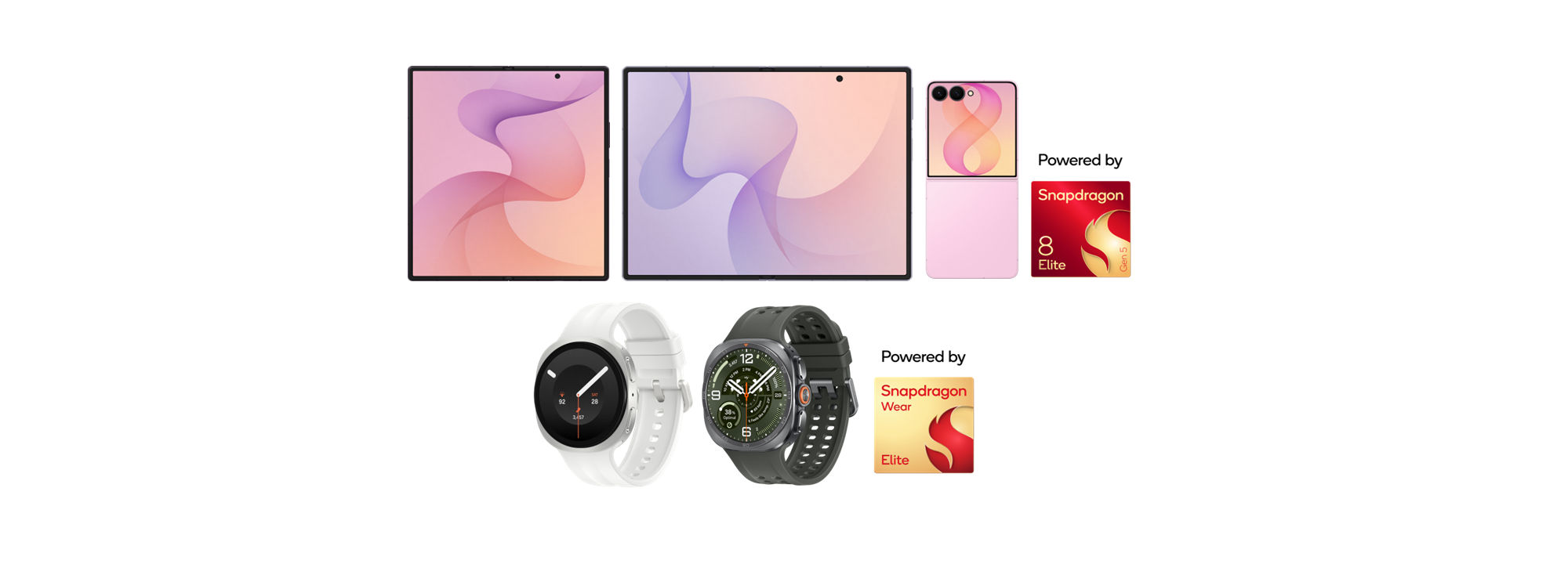
Qualcomm’s separate July 22 press note confirms the hardware foundation behind the wider ecosystem. It says the Snapdragon 8 Elite Gen 5 for Galaxy powers the new foldable smartphones, while Snapdragon Wear Elite powers the Galaxy Watch9 and Galaxy Watch Ultra2. Qualcomm also identifies Snapdragon AR1 Gen 1 as the platform for Samsung and Google’s new intelligent eyewear.
This matters because Samsung is presenting the watch and eyewear as sources of continuing context rather than simple accessories. The company says connected devices can support more continuous interactions, from wellness information to routines and other actions. Qualcomm similarly describes the combination as a connected Galaxy ecosystem, while noting that the Snapdragon platform powers the Galaxy Z Flip8 in select regions. The announcements establish the intended architecture, but they do not prove that users will experience seamless hand-offs in every network, app or market.
Samsung is also trying to lower the cost of switching into that ecosystem. The updated Smart Switch can let iPhone users scan a QR code and transfer data wirelessly without downloading another app, according to the company. Samsung also says Quick Share now works with AirDrop for two-way file sharing between iOS and Galaxy devices. Passwords, passkeys, call history, accessibility settings and eSIM data are among the additional data types Samsung lists for migration.
Privacy is therefore central to the pitch. Samsung says the Personal Data Engine supports on-device personalisation, while Knox Enhanced Encrypted Protection creates app-specific encrypted storage and Knox Vault protects sensitive information in a tamper-resistant hardware layer. One UI 9 adds an AI Assistant Activity dashboard so users can review automations, and Samsung says Privacy Alerts can flag potentially unnecessary background permission requests.
Those controls are a useful counterweight to the more ambitious AI language. A system that can act across apps needs to show what it did, which data it used and where responsibility sits when an action fails. Samsung’s dashboard and alerts address that problem in principle. The practical test will be whether users can understand the controls without consulting a manual, and whether the choices remain visible as more services join the platform.
Samsung says pre-orders for the Galaxy Z Fold8 Ultra, Fold8 and Flip8 began on July 22 in select markets. The company has not made one universal availability or configuration promise in the announcement, so buyers will need to check local listings for exact models and options. For now, the significant news is strategic: Samsung is treating foldables as the physical interface for an AI system that spans phones, apps, watches and eyewear. The hardware specifications may attract attention at launch, but the long-term question is whether that connected intelligence becomes dependable enough to justify the extra complexity.