
News
Samsung and KDDI Report Up to 52% 5G Gain in AI Trial
Samsung and KDDI report an average 31% increase in 5G downlink throughput during a commercial 5G Standalone trial in Japan, with gains reaching 52% in dense urban areas.
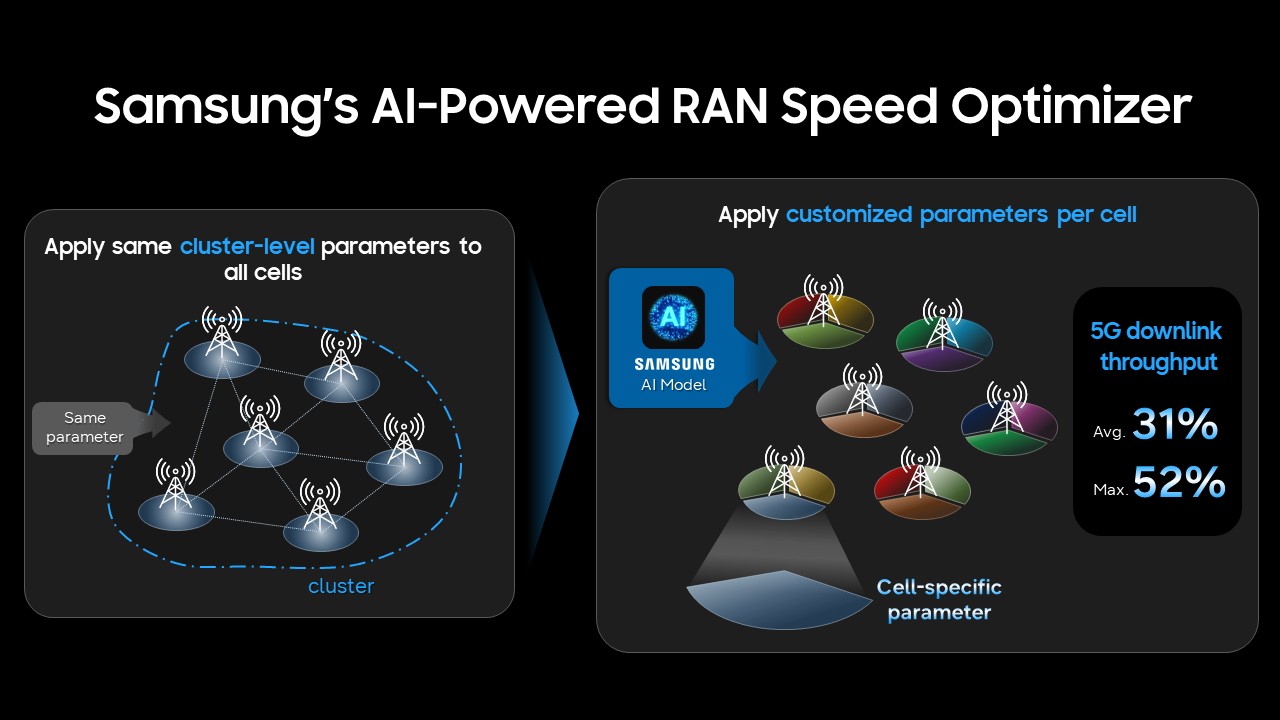
Samsung and KDDI say an artificial-intelligence system improved 5G downlink throughput during a field trial on KDDI’s commercial 5G Standalone network in Japan. The result is notable because the software was evaluated across a live operator environment rather than a single laboratory cell, but it remains a vendor-reported trial result rather than an independent benchmark.
In an announcement dated June 30, 2026, Samsung said its AI-powered RAN Speed Optimizer, or RSO, delivered an average 31% increase in 5G downlink throughput across the overall trial area during peak hours. In dense urban areas, the maximum reported increase reached 52%. Those figures describe the change recorded in the trial conditions; they are not a promise that every KDDI customer will see the same improvement.
What Samsung and KDDI actually tested
The joint work ran for several months after starting in late 2025. Samsung said the trial took place in and around Tokyo and covered dense urban, suburban and rural environments. The test used 100 MHz of 3.7 GHz time-division duplex spectrum and extended across hundreds of cells. That combination matters because radio performance can change sharply with traffic, geography and the way neighboring cells interact.
The companies evaluated RSO during peak hours, when demand puts more pressure on a mobile network. Samsung describes the system as an AI-based prediction model that examines site-environment data and recommends optimized parameters for each individual cell. Traditional optimization can apply the same settings to a wider cluster of cells. Per-cell recommendations are intended to account for local conditions instead of treating every location in a group as if it behaved identically.
Samsung places RSO inside its CognitiV Network Operations Suite, which combines network automation tools, AI agents and other intelligent applications. In practical terms, the announced workflow is about helping an operator identify better radio settings and reduce the amount of manual tuning required. The source does not say that the system autonomously changed every network parameter without human oversight, and it does not disclose the exact settings, baseline throughput values, device mix or traffic volumes used to calculate the percentages.
Why the result matters for phone users
For people using smartphones, a network-side optimization can influence the experience of apps that depend on a stable downlink: video streaming, cloud backups, large downloads, social feeds and voice or video calls. If a busy cell can carry data more efficiently, users may encounter fewer slowdowns at the same time and in the same area. That is the consumer-facing logic behind the trial, although the announcement does not provide app-level measurements, latency figures or a breakdown by handset.
The more important shift is operational. 5G Standalone networks are designed around a cloud-native core and a radio access network that can be managed with software. Samsung and KDDI are testing whether AI can turn the large amount of information collected from those networks into cell-specific recommendations. An operator could then use those recommendations to respond more precisely to changing conditions instead of repeatedly applying broad settings across an entire cluster.
That approach could be useful in cities, where a small change in traffic, building density or neighboring-cell interference can affect the result from one site to the next. It may also help explain why the reported maximum was higher in dense urban areas than across the full trial footprint. That is an interpretation of the conditions described by Samsung, not a separate finding from an independent measurement.
What the announcement does not establish
The figures should be read with the scope of the test in mind. Samsung and KDDI report a 31% average increase across their trial area and a 52% maximum increase in dense urban locations, but they do not publish a complete methodology for reproducing the comparison. The release does not identify the before-and-after measurement window, the number of samples, the traffic profile, the test devices or whether other network changes were held constant.
That missing detail does not make the announcement irrelevant. It does set a boundary around the claim: this is evidence that the RSO approach produced measurable gains in one commercial 5G SA deployment, not proof of a universal percentage uplift. Independent operator data, longer-term monitoring and results from different spectrum bands or network vendors would be needed to judge how widely the result generalizes.
Samsung and KDDI say they will continue evaluating AI-based optimization for broader commercial network applications. The companies also point to their earlier collaboration on fully virtualized network deployments as a foundation for moving toward AI-native network operations. No customer launch date, pricing information or promise of a direct smartphone setting was included in the announcement.
For now, the story is less about a new phone feature than about the infrastructure behind everyday mobile apps. If similar trials continue to show consistent gains under different conditions, cell-level AI tuning could become one of the quieter ways operators improve 5G: through software decisions made in the network, before a handset ever displays a stronger or faster connection.
Source: Samsung Global Newsroom.