
News
Samsung and LG Uplus team up to explore 6G sensing networks
Samsung Electronics and LG Uplus will research Integrated Sensing and Communication, a 6G concept that could use mobile networks to detect movement and understand surrounding environments.
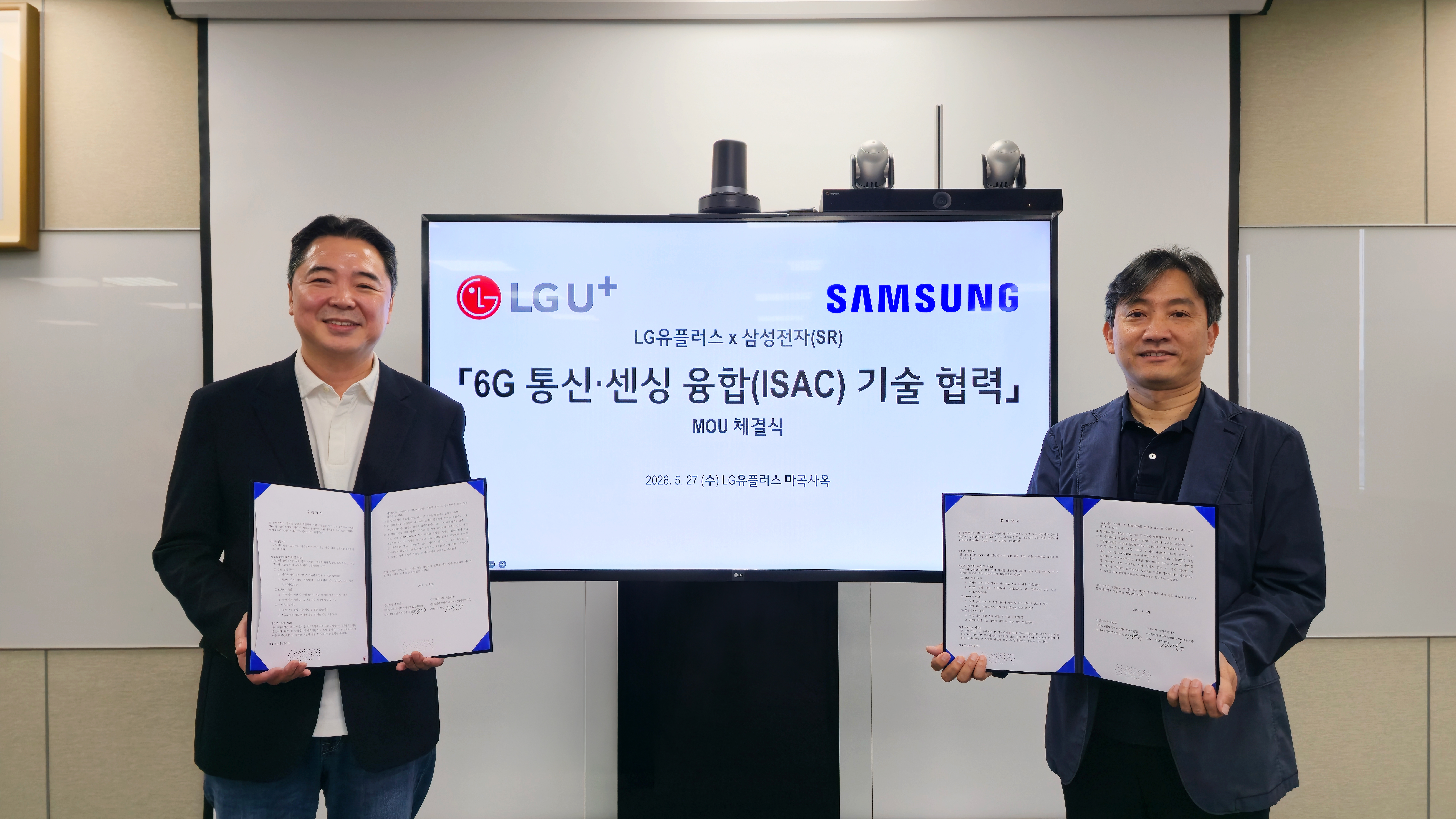
Samsung Electronics and LG Uplus are joining forces to explore a mobile network that can do more than carry data. In a May 29 announcement, the companies said they had signed a memorandum of understanding to research Integrated Sensing and Communication, or ISAC, as part of their work toward 6G.
The idea is still a research programme, not a new smartphone feature or a consumer service. Its importance is that it treats the cellular network itself as a sensing layer. Instead of relying only on dedicated radar or LiDAR hardware, a future network could use the radio signals already travelling between base stations and devices to understand what is happening around it.
From connectivity to environmental sensing
According to Samsung’s official announcement, ISAC analyses how wireless signals reflect off nearby objects. Those reflections can provide information about an object’s speed, distance and direction of movement. The approach could use existing cellular or Wi-Fi infrastructure, reducing the need to install a separate sensor for every location where detection is useful.
That distinction matters for mobile technology. A conventional camera can struggle in low light or when its line of sight is blocked, while radio-based sensing can work in conditions where an image is unavailable. Samsung and LG Uplus say ISAC could help identify human movement, track drones and robots, monitor traffic congestion or observe changes in weather. These are possible applications under investigation, not features that users can activate on a Galaxy phone today.
The companies also describe a potential safety role. A network able to detect movement could support alerts around hazardous areas or help operators understand how people are moving through a site. In an industrial setting, the same data might help improve operational efficiency. The practical value will depend on accuracy, response times, spectrum conditions and how the system handles personal data.
What Samsung and LG Uplus plan to validate
Samsung Research, Samsung’s advanced research organisation, will develop core ISAC and AI-based 6G technologies. LG Uplus will lead validation work, provide data and prepare field-testing infrastructure, drawing on its experience running mobile networks. The partners plan to examine performance on existing 5G networks as well as in the 7 GHz band, which Samsung describes as a candidate frequency for 6G.
The first phase is deliberately grounded in practical use cases. The companies say they will focus on human detection for everyday safety and on improving network operations. They also plan to combine wireless sensing data, such as location, speed and density information, with camera imagery. That multimodal approach is intended to improve detection accuracy, while also supporting the development of AI systems that can analyse images, audio, video and radio-derived information together.
This is a different proposition from simply adding another sensor to a phone. The intelligence would sit across the network, radio equipment and software, potentially allowing operators to observe larger areas than a handset camera can cover. A smartphone could remain the user-facing endpoint for alerts or services, but the announcement does not say that a current handset will independently function as a radar.
Why the announcement matters for 6G
ISAC has been identified by the ITU Radiocommunication Sector as one of three key usage scenarios for 6G. That places sensing alongside the wider conversation about what mobile networks should provide after 5G. The technology could eventually connect communications, location awareness and automation in one platform, rather than treating each capability as a separate system.
For consumers, the most visible effects would likely appear indirectly. A future phone might receive more useful safety notifications, benefit from better awareness of crowded spaces or interact with services built on network-level detection. For businesses and public services, the potential applications are broader: monitoring restricted areas, supporting robots, tracking traffic or improving responses to changing conditions.
There are also important limits to keep in view. Samsung and LG Uplus have announced joint research and planned validation; they have not announced a commercial ISAC launch, a supported smartphone list, a rollout schedule or a consumer application. The companies will need to demonstrate reliable performance in real environments before the concept can move from a laboratory and field-testing programme into an everyday mobile service.
A long road from proof of concept to service
The partnership is therefore best understood as an early step in defining what a 6G network might become. The immediate question is not whether phones will suddenly see through walls, but whether operators can turn radio reflections into dependable, privacy-conscious information without disrupting calls, messaging or internet access.
Samsung and LG Uplus say their collaboration will continue with real-world validation. That work should reveal where ISAC is genuinely useful, how much network infrastructure it needs and how operators can combine its data with other sensing systems. Until those questions are answered, the announcement offers a credible direction for mobile research rather than a product promise: connectivity may eventually help networks understand their surroundings as well as connect the people and devices inside them.