
News
Samsung Details Wearable AI Models for Continuous Health Insights
Samsung Research has outlined xMAE and HiMAE, two foundation models designed to interpret wearable biosignals more efficiently and support future on-device health insights.
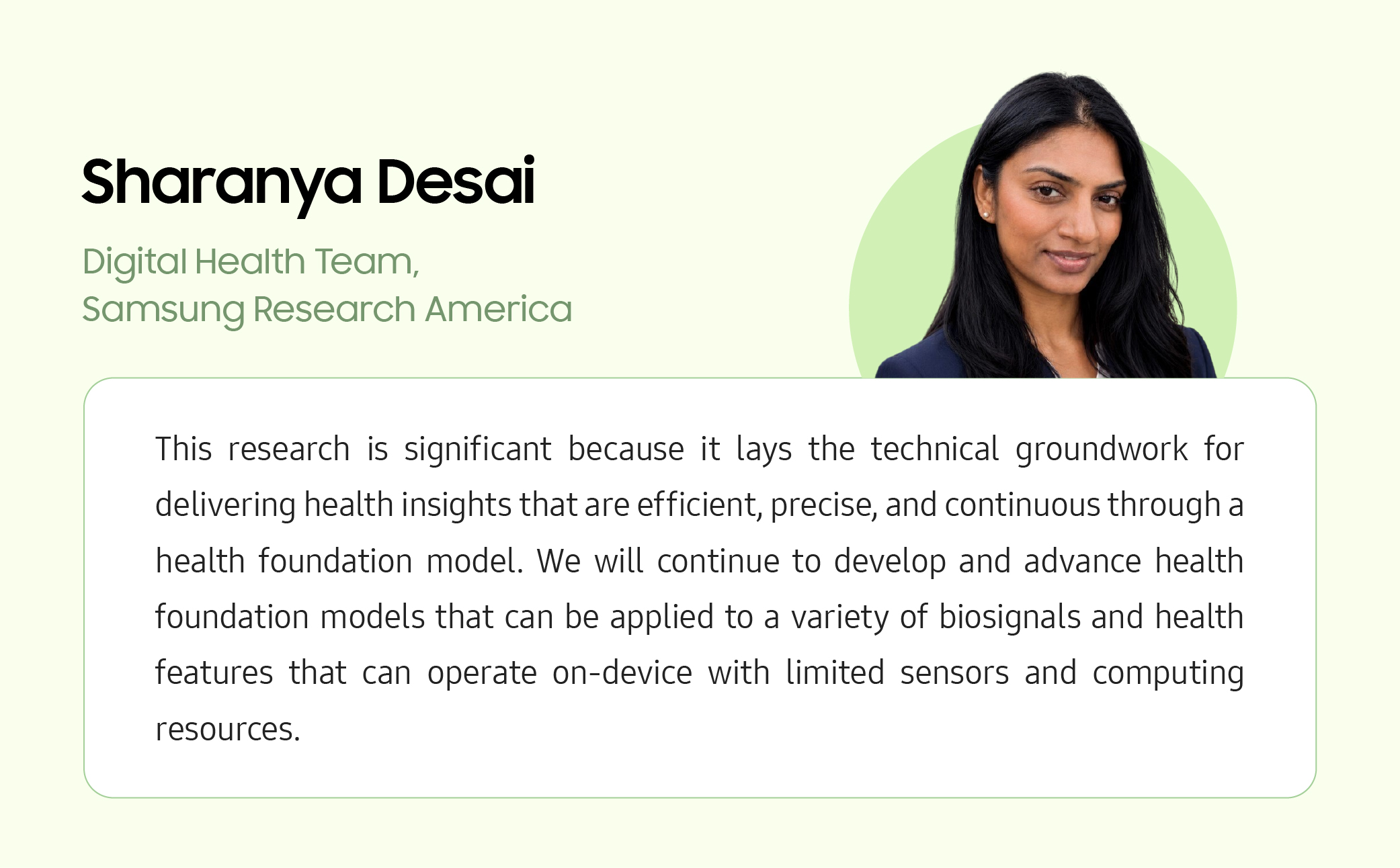
Samsung Research has published new details about two artificial intelligence models designed to interpret health signals collected by wearable devices. In an official Samsung Newsroom report published on August 14, 2026, the company explained how xMAE and HiMAE are being developed to identify meaningful patterns in signals such as heart activity, sleep and physical movement.
The work is part of Samsung’s broader Connected Care vision, which aims to move digital health toward more preventive, personalized and connected experiences. It remains research rather than a consumer product announcement: Samsung has not announced a release date, supported device list or immediate software update for either model.
Why wearable biosignals are difficult to interpret
Smartwatches can collect several types of physiological data, but those signals do not all describe the body in the same way or at the same speed. An electrocardiogram, or ECG, directly measures the heart’s electrical activity. Photoplethysmography, or PPG, uses changes in blood flow to estimate cardiac activity and can be captured passively through optical sensors in a wearable.
ECG measurements can provide detailed information, but they generally require the wearer to stop and actively take a reading. PPG can be recorded more continuously, yet it is an indirect signal that must be interpreted carefully. Samsung’s research focuses on helping AI understand the relationship between these signals instead of treating each measurement as an isolated data point.
xMAE learns the relationship between ECG and PPG
The first model, xMAE, is a biosignal pretraining framework designed to learn the timing relationship between ECG and PPG. Samsung compares the concept with lightning and thunder: both originate from the same event, but the signals arrive with a measurable delay. In the model’s case, the relationship between electrical heart activity and the pulse signal at the wrist can help the system infer missing portions of ECG data from more continuously available PPG data.
According to Samsung Research, xMAE was pretrained using approximately 9,400 hours of ECG and PPG data. In the company’s reported evaluation, it outperformed unimodal biosignal models and existing multimodal learning methods in 15 of 19 tasks. Those tasks included cardiovascular disease prediction, abnormal test-result detection and sleep-stage classification.
Samsung also said the learned features showed potential across different sensor devices, body locations and data-collection environments. That matters because wearable data is not collected under identical conditions: sensor placement, device design and everyday movement can all affect the signal. A model that generalizes across those variables could make future health applications less dependent on one specific sensor configuration.
HiMAE looks at health data across time scales
The second model, HiMAE, is designed to analyze wearable time-series data at multiple time scales. Short segments can reveal rapidly changing events such as individual heartbeats, while longer segments can show patterns that build over minutes or hours, including sleep and physical activity. HiMAE uses separate encoders for short and long segments so that the model can focus on the time frame most relevant to each task.
Samsung describes HiMAE as a self-supervised model. During training, it reconstructs masked portions of wearable data, allowing it to learn useful representations even when large quantities of manually labelled health data are unavailable. The company says a single pretrained model can support classification, numerical prediction and data generation.
Samsung also reported that HiMAE produced results in less than one millisecond on a smartwatch-class central processing unit and demonstrated the potential for on-device health foundation models. Processing raw signals locally could reduce dependence on cloud servers, but the research result should not be confused with a confirmed consumer implementation. Samsung has not said which products, applications or health services will use the model.
What this means for mobile health
The significance of the announcement is less about a new watch feature today and more about the technical direction it reveals. Foundation models trained on biosignals could eventually give mobile health applications a shared starting point for tasks such as sleep analysis, cardiovascular monitoring or activity interpretation. A single adaptable model could also make it easier to support new health features without building an entirely separate system for every measurement.
Samsung said the xMAE and HiMAE studies were accepted at the International Conference on Machine Learning and the International Conference on Learning Representations, respectively. That recognition supports the research contribution, but it does not establish clinical effectiveness or regulatory approval. Samsung’s published evaluation results are also not the same as an independent medical validation or a human product test.
For users, the practical takeaway is therefore limited but important: wearable health intelligence is moving toward continuous signal interpretation and more local processing, while the consumer impact remains to be announced. Until Samsung provides product-specific information, existing smartwatch readings should be treated as informational rather than diagnostic. Anyone concerned about a health result should seek advice from a qualified medical professional rather than relying on an AI-generated insight alone.