
Noticia
Samsung Galaxy Watch Study Finds a Five-Minute Fainting Warning Signal
A Samsung-backed clinical study suggests Galaxy Watch biosignals could help predict vasovagal fainting before it happens, while highlighting the limits of current wearable health research.
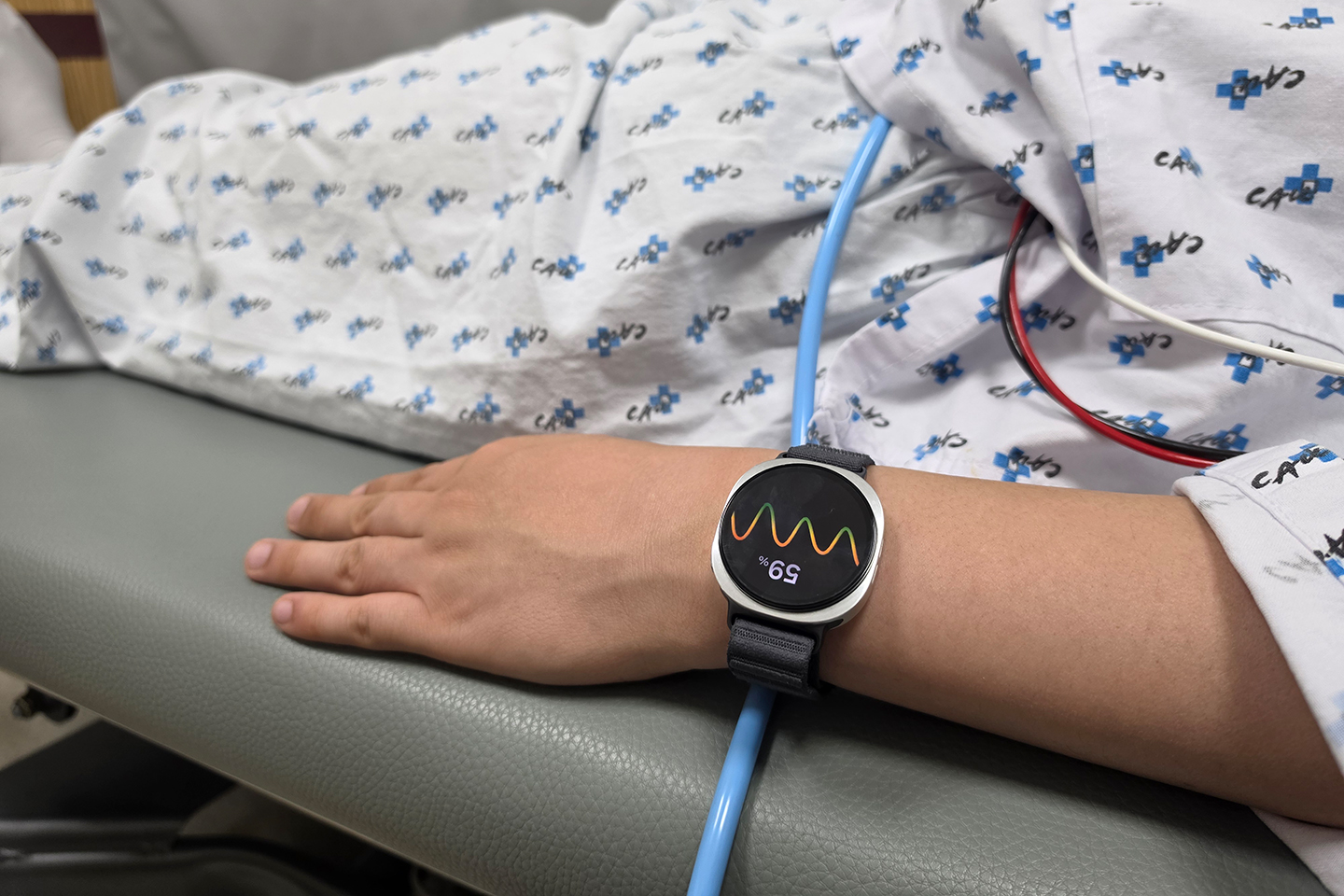
Samsung says a joint clinical study with Chung-Ang University Gwangmyeong Hospital has demonstrated the potential for a Galaxy Watch to predict vasovagal syncope, a common form of fainting, several minutes before loss of consciousness. The company announced the results on May 7, 2026, describing the work as a possible step toward real-time warning systems for wearable devices.
The result is notable because it uses signals already captured by a commercial smartwatch rather than hospital-grade equipment alone. It is also a useful reminder that wearable health features often begin as research projects long before they become functions available in a consumer app.
What the study actually measured
The research team evaluated 132 patients with suspected vasovagal syncope during induced fainting tests. Each participant wore a Samsung Galaxy Watch6 while undergoing head-up tilt testing, a controlled clinical procedure used to study fainting responses. The watch collected photoplethysmography, or PPG, data from its optical sensor. PPG measures changes in blood volume beneath the skin and is commonly used by smartwatches to estimate heart rate and related metrics.
Researchers converted the watch data into heart-rate-variability features and trained an artificial-intelligence model to distinguish participants who developed syncope from those who did not. The peer-reviewed paper, published in European Heart Journal – Digital Health, describes a subject-level 80/20 training and hold-out evaluation split, with no participant appearing in both groups.
A five-minute window produced the strongest result
According to the study, the model performed best when it analysed a five-minute observation window close to the fainting event. At a fixed sensitivity of 90 percent, specificity was 64 percent. The paper reports an area under the receiver operating characteristic curve of 0.91 for the five-minute window, with an accuracy of 84.6 percent when the model was used at a five-minute lead time.
Those figures describe performance under the study protocol, not a guarantee that a Galaxy Watch can warn every wearer in everyday life. Specificity of 64 percent also means that some people without an impending fainting episode could be flagged by the model. That trade-off matters for any alert system: missing an event and producing too many false alarms create different safety problems.
Why the approach matters for mobile health
The technical idea is relatively straightforward. Vasovagal syncope involves changes in the autonomic nervous system, which can affect heart-rate patterns before blood pressure drops and consciousness is lost. A smartwatch cannot directly measure every part of that process, but its optical sensor can collect continuous pulse information without requiring the wearer to stop and perform a manual reading.
The study used 107 heart-rate-variability features, including time-domain, frequency-domain and nonlinear measurements. The authors found that the five-minute window captured the most useful short-term changes, while longer windows could introduce more normal variation and reduce discrimination. That finding points toward a model that runs continuously in the background and looks for abrupt physiological changes rather than relying only on occasional spot checks.
It also illustrates why the smartphone remains important even when the sensor is on the wrist. A future consumer implementation would need a watch, a companion phone, an app interface, alert logic, permissions and a carefully designed escalation path. The research result alone does not establish how such a system would behave when the watch is loose, the wearer is moving, the optical signal is noisy or the phone connection is unavailable.
The study has clear limitations
The participants were assessed in a controlled hospital setting using induced head-up tilt testing. That is valuable for collecting labelled data, but it does not reproduce every circumstance in which people faint. The sample contained 132 people with suspected symptoms, and the paper reports 63 head-up-tilt-positive and 69 head-up-tilt-negative participants. Larger studies across different populations and real-world environments would be needed to establish how well the approach generalises.
The research also evaluated a specific algorithm and a specific data-collection setup. Performance can change with watch fit, skin contact, motion, sensor placement, software processing and the type of fainting episode. The results should therefore be read as evidence of feasibility, not as proof of a finished medical product.
No consumer feature has been announced
Samsung’s announcement says the company plans to continue advancing wearable health monitoring and collaborating with medical institutions. It does not announce a Galaxy Watch fainting-prediction feature, a Samsung Health rollout, a release date or regulatory clearance for this capability. The study should not be used to diagnose syncope or to replace medical advice.
For now, the practical significance is that a mainstream wearable was able to support a clinically structured investigation using passive biosignals. If future research confirms the result in larger and less controlled settings, it could inform new approaches to preventive alerts on watches and phones. Until then, the most responsible conclusion is narrower: Samsung and its clinical partners have shown that a Galaxy Watch6 signal can contain useful information about an impending vasovagal event under test conditions, but the path from research finding to dependable everyday warning system remains open.