
Noticia
Snapchat Adds Spotify Listening Status to Snap Map
Snapchat’s new Now Playing feature connects Spotify listening activity to Snap Map, Spotlight and Sound Pages while letting users choose exactly who can see their status.
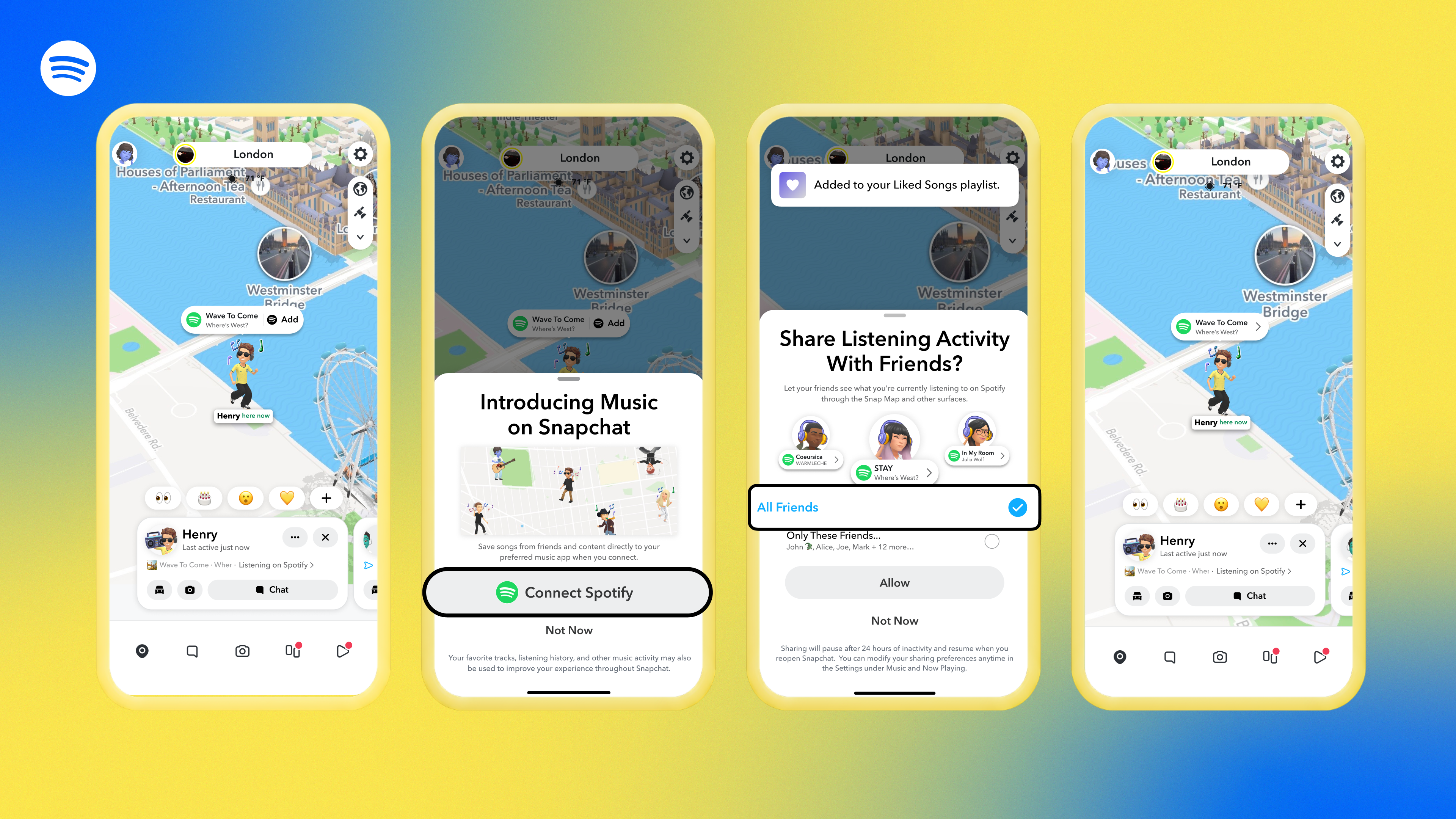
Published July 27, 2026. Snapchat is adding a new music-sharing layer to Snap Map. Its Now Playing feature connects Snapchat with Spotify so users can show what they are listening to, discover tracks through friends and save songs without leaving Snapchat’s mobile experiences.
Snap announced the feature on July 27, describing it as a way to share listening activity with friends through the same map that already supports location-based conversations and discovery. The company says more than 450 million people use Snap Map each month. Spotify is the starting partner for the integration, and Snap has not announced additional music services as part of this launch.
How Now Playing works
After linking a Spotify account, Snapchat users can see what selected friends are listening to in real time on Snap Map. A track can be opened in Spotify, saved to the user’s Liked Songs, or used to find Spotlight videos built around the same sound. Snap also says songs can be saved directly from Spotlight videos and Sound Pages, extending the feature beyond the map itself.
The Spotify connection can be started from several places inside Snapchat: Snap Map, Sounds, a friend’s profile or the app’s Settings. That gives users more than one way to activate the integration, but the important step comes after linking the account: Snapchat asks users to decide who can see their Now Playing status.
Four visibility choices
Snapchat offers four audience settings for listening activity:
Friends: share the status with Snapchat friends.
Friends on the Map: share it only with friends who already receive the user’s location on Snap Map.
Select Friends: choose specific people.
No one: keep the listening activity private while retaining the account connection.
The distinction between Snapchat friends and friends on the Map matters. The second option is tied to an existing location-sharing relationship, while Select Friends provides a narrower audience. Users who want to try the feature without broadcasting their listening activity can choose No one. The announcement does not describe a requirement to share live location with all Snapchat contacts in order to use Spotify linking.
A social discovery feature, not a new music player
Now Playing is best understood as a bridge between Snapchat’s social graph and Spotify’s music catalogue. Snapchat is not replacing Spotify playback. Instead, it is adding a visible signal to Snap Map and connecting that signal to Spotlight videos, Sound Pages and Spotify’s save and playback actions.
That approach could make music discovery more contextual. A song appears alongside the people and places users already explore in Snapchat, rather than only inside a dedicated streaming-app recommendation feed. Tapping a friend’s track may lead to related Spotlight videos, while a song encountered in a video can move in the opposite direction into Spotify. These are the specific pathways Snap announced; the company did not publish independent usage results for the feature.
The integration also keeps the user’s control close to the feature itself. Because the audience can be changed among four options, a user can begin with a restricted setting and expand it later, or turn off visibility without necessarily removing the Spotify connection. Snapchat’s announcement does not claim that the feature makes listening activity visible to everyone by default.
Availability and limits
Snap says Now Playing is available wherever both Spotify and Snapchat are available, with Canada listed as coming soon in the launch announcement. Availability can therefore depend on both services and the user’s market. Snap also identifies Spotify as the initial integration, so the announcement should not be read as confirmation of support for Apple Music, YouTube Music or other streaming platforms.
The feature’s usefulness will depend on how many friends choose to connect Spotify and share their status. A user may see little activity if friends select No one, use Select Friends, or do not link an account. The same privacy controls that make the feature more flexible can also make the map less populated with listening activity, which is an expected trade-off rather than a technical failure.
For users who want to try it, the safest starting point is to link Spotify through a known Snapchat entry point, select No one or Select Friends first, and review the audience before enabling broader sharing. Anyone who shares location through Snap Map should pay particular attention to the Friends on the Map option, because it links music visibility to an existing location-sharing group.
Snap’s July announcement positions Now Playing as a small but notable expansion of what Snap Map can represent. It adds a live listening status, music discovery through Spotlight and Sound Pages, and direct Spotify saves while preserving explicit controls over the audience. The result is a tighter connection between messaging, location-based discovery and streaming, with privacy settings determining how social that connection becomes.