
Actualité
Google expands Android app verification with a public transparency ledger
Google says a public cryptographic ledger will record production Google apps and Mainline modules released after May 1, giving Pixel users and researchers a way to check whether Android software matches an authorized build.
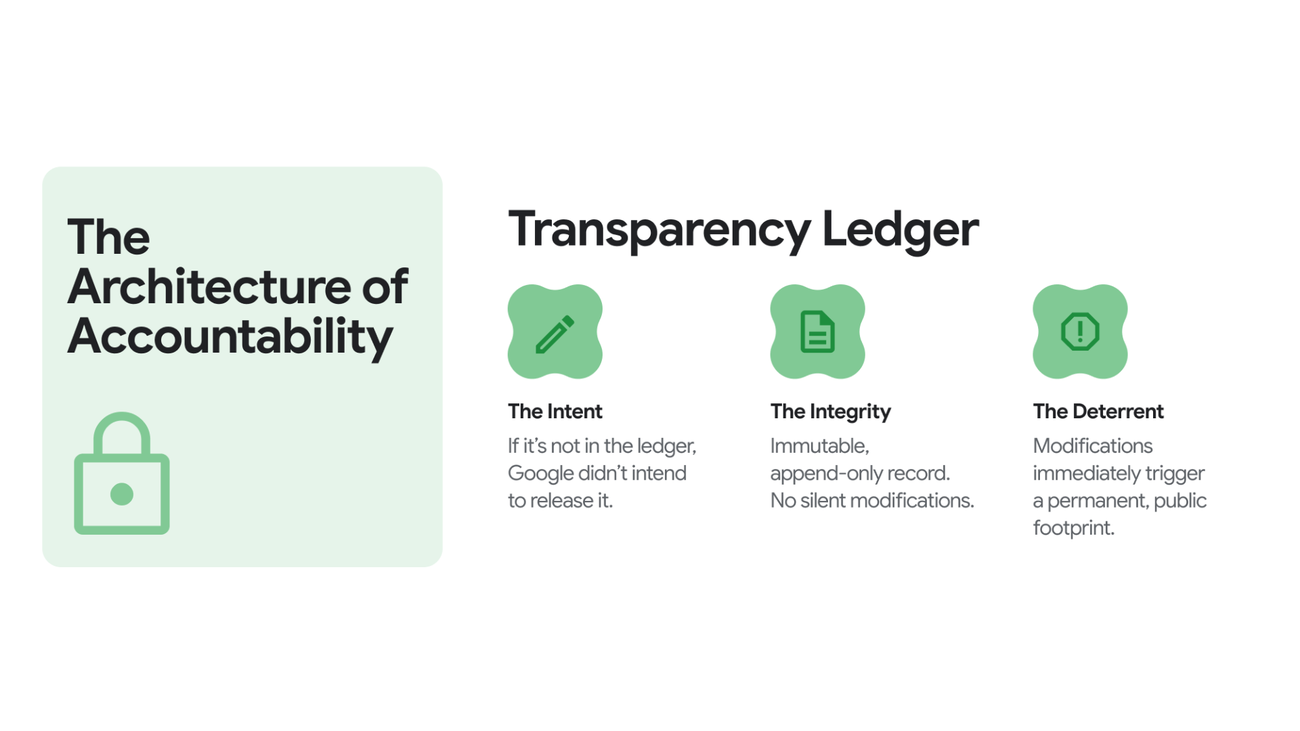
Google is expanding the security model behind Android software updates with a public cryptographic ledger designed to show whether production software was authorized for release. The initiative, described in Google’s Android Binary Transparency announcement, covers Google applications and selected Mainline modules distributed across the Android ecosystem.
The change addresses a difficult question for mobile security: a valid digital signature can show who signed an application, but it does not by itself provide a public record proving that the signed file was intended for production. Google’s expanded transparency system adds that record. For supported software, an entry in the ledger acts as an independently verifiable reference for what Google says it authorized.
What Android Binary Transparency records
Google says production Android applications released after May 1, 2026, will have a corresponding cryptographic entry. The scope includes Google Play services and standalone Google applications that support Android devices, along with dynamically updateable Mainline modules. These modules operate at elevated privileges and can be updated independently of a full operating-system release, which makes their integrity especially important.
The ledger is intended to function as a public source of truth. If a Google-signed application released after the stated cutoff is not present, Google says it did not intend to release that production version. The approach therefore creates an additional layer of accountability around software distribution: an unauthorized build may carry a technically valid signature, but it should still be visible as missing from the public record.
Why the ledger matters for phone security
Android devices increasingly depend on software that can change without a major operating-system upgrade. Google Play services, system components and other privileged packages can receive frequent updates because they deliver security fixes, connectivity features and platform capabilities. That speed is useful, but it also increases the importance of being able to distinguish an official build from a modified or improperly distributed one.
Binary transparency does not replace signatures, secure update channels or malware scanning. Instead, it adds a way to compare the software installed on a device with an externally visible record of authorized production artifacts. Google says the system is designed so that no party, including Google, can alter the software it authorizes without creating a public record of that change.
That model is particularly relevant to supply-chain attacks, in which an attacker attempts to insert altered software somewhere between a developer’s build process and a user’s phone. A transparent ledger cannot prevent every compromise, but it can make an unauthorized release easier to detect and investigate. Researchers can also use the published metadata to look for inconsistencies across supported Android software.
Pixel users get the clearest verification path
For Pixel owners, Google positions Binary Transparency as a companion to its existing Pixel System Image Transparency work. Together, the systems can provide a way to verify both the operating-system image and supported Google applications installed on the device. Google has also published verification tooling so researchers and technically inclined users can inspect the transparency state of eligible software.
This is a meaningful distinction from a conventional “downloaded from Google” assurance. The new process is based on cryptographic metadata and a public record rather than only on the location from which an update was obtained. It should help security teams and independent researchers confirm that the software under examination corresponds to a production release Google intended to distribute.
What the announcement does not cover
The initiative is not a universal ledger for every Android application available through Google Play. Google’s announcement focuses on its own production applications and selected Mainline modules. Third-party developers, alternative app stores and applications distributed outside the covered software categories are not automatically included by this announcement.
That limitation matters because Android’s software supply chain is broad. Users still need to keep Play Protect enabled, install applications from trustworthy sources and apply security updates promptly. Binary transparency can improve confidence in supported Google software, but it does not certify the behaviour, privacy practices or safety of every application on a phone.
A more accountable update model
Google’s broader argument is that software trust should be verifiable rather than implicit. As Android becomes a platform for payments, identity documents, private communications and AI-powered features, the ability to check whether privileged software is genuine becomes more important. A public ledger gives security researchers a shared reference point and gives Google a clearer way to demonstrate what it meant to release.
The practical impact will depend on how widely the system is used, how accessible the verification tools become and whether more Android vendors adopt similar transparency mechanisms. For now, the announcement represents a focused step: Google is extending cryptographic accountability beyond the signature on an Android package and into the release history of the software itself.