
Actualité
OPPO Find N6 makes the near-flat foldable a software story
OPPO’s Find N6 combines a redesigned hinge, a near-flat inner display and four-app multitasking, with regional availability and performance claims still dependent on the company’s official specifications.
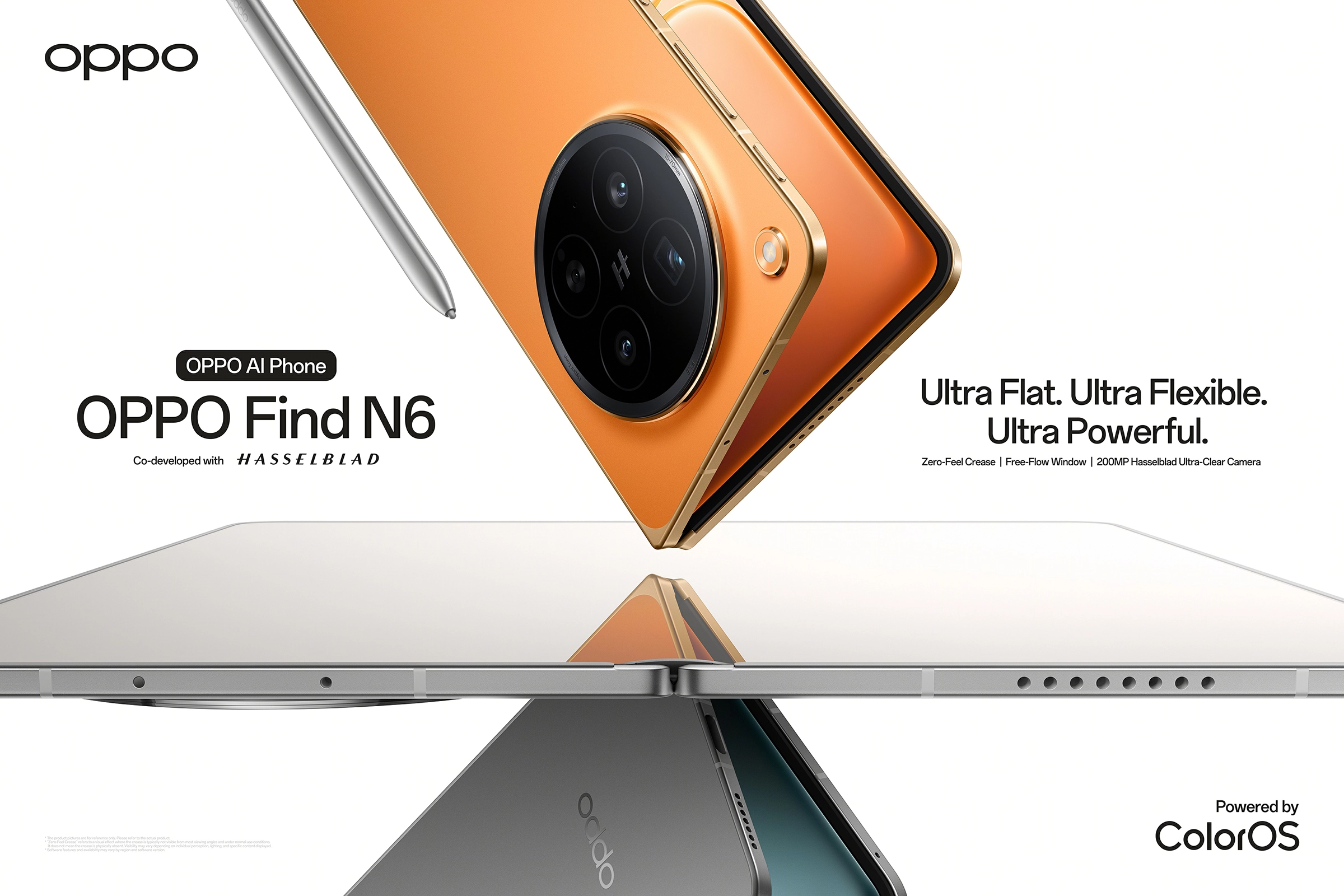
OPPO is positioning the Find N6 as more than another large-screen foldable. In an official announcement dated April 2, 2026, the company presented its latest flagship around two connected ideas: making the inner display appear almost flat in everyday use and making that larger canvas useful for serious multitasking. The launch also brings ColorOS 16, an AI Pen and a camera system aimed at users who want one device for work, photography and entertainment.
The most distinctive part of the announcement is OPPO’s “Zero-Feel Crease” claim. The company says the Find N6 uses a second-generation Titanium Flexion Hinge manufactured with 3D Liquid Printing. OPPO describes a process in which laser scanning identifies microscopic irregularities, then photopolymer droplets are applied and cured with ultraviolet light. After more than 20 printing and solidification cycles, the company says hinge-height variation is reduced from 0.2mm to 0.05mm.
That figure is a manufacturer claim rather than an independent measurement, but it explains the engineering direction. Foldables have always traded portability for a visible transition across the flexible panel. OPPO’s approach focuses on the hinge and the glass together, rather than treating the crease as a problem that can be solved by software or screen brightness alone. The company says its Auto-Smoothing Flex Glass improves shape recovery by nearly 100 percent and deformation resistance by 338 percent compared with the previous generation.
OPPO also cites TÜV Rheinland certifications in its official Find N6 launch announcement. According to the company, the phone remains flat after 600,000 folds and completed a separate reliable-folding test covering one million cycles. OPPO says the TÜV Rheinland testing also found up to an 82 percent reduction in long-term crease formation compared with the Find N5. Those results should be read as certified or manufacturer-reported test figures, not as a substitute for long-term independent ownership data.
A larger display with a clearer purpose
The Find N6 has a 6.62-inch cover display and an 8.12-inch inner screen. OPPO lists peak brightness of 1,800 nits, a 1-nit minimum brightness and up to 2,160Hz high-frequency PWM dimming for both panels. The company also lists IP56, IP58 and IP59 dust and water-resistance certifications. As with any foldable, the practical value will depend on how the hinge, flexible panel and sealing perform after repeated daily use. OPPO itself notes that water resistance can decline through wear and that the phone should not be charged while damp.
The more relevant change for many users may be in the software. Free-Flow Window is designed to let up to four applications run simultaneously on the unfolded display, with adjustable window sizes and aspect ratios. Boundless View is intended to make it easier to move between a dense multitasking layout and a focused primary task. That could make the Find N6 more useful for comparing documents, taking notes during a call or keeping a reference page open while writing.
There are limits. OPPO states that some applications may not support every Free-Flow Window function, so the feature should not be treated as a universal desktop replacement. The phone also includes AI Mind Space, AI Recording and AI Motion Photo Popout, while O+ Connect supports file transfers with Mac or Windows PCs, screen mirroring and remote control. These tools make the foldable’s value depend as much on app compatibility and cross-device setup as on the hardware itself.
The optional OPPO AI Pen extends that productivity focus. The stylus supports 4,096 pressure levels and functions including Quick Note, Global Annotation and a laser-pointer mode. OPPO also lists Circle to Capture, AI Chart and AI Image, which are designed to turn marked-up screen content, rough diagrams or handwritten material into more structured results. The usefulness of these features will depend on language support, application compatibility and how much processing happens locally, details that users should check in their market before buying.
Flagship hardware, with regional caveats
OPPO lists Qualcomm’s Snapdragon 8 Elite Gen 5 Mobile Platform, a 6,000mAh silicon-carbon battery, 80W wired charging and 50W wireless charging. The rear camera system combines a 200MP Hasselblad Ultra-Clear main camera with 50MP ultra-wide and 50MP three-times periscope telephoto cameras. OPPO says the rear cameras support 4K 60fps Dolby Vision recording, while the main sensor can reach 4K 120fps Dolby Vision. Log video support is included for workflows that require later colour grading.
The launch announcement gave the UAE-specific commercial details: pre-orders from April 2 to April 9, a first sale on April 10, AED 8,999 pricing and a 16GB/512GB configuration. OPPO also said that availability, memory configurations and pricing can vary by market. That distinction matters for a global foldable, particularly because accessories such as the AI Pen, network-band support and repair arrangements may not be identical everywhere.
For now, the Find N6 is best understood as an engineering and software statement from OPPO. Its near-flat display addresses one of the category’s most visible compromises, while Free-Flow Window and O+ Connect attempt to make the additional screen practical rather than merely impressive. Independent durability, battery and camera testing will be needed before judging whether the company’s claims translate into a better long-term foldable experience.