
Actualité
Qualcomm outlines a 6G blueprint for AI traffic, uplink and smarter phones
Qualcomm’s latest 6G outlook shifts attention from headline download speeds to uplink coverage, energy efficiency and device autonomy. The proposals are not yet a finished standard, but they show how future smartphones and mobile apps could be designed around continuous AI workloads.
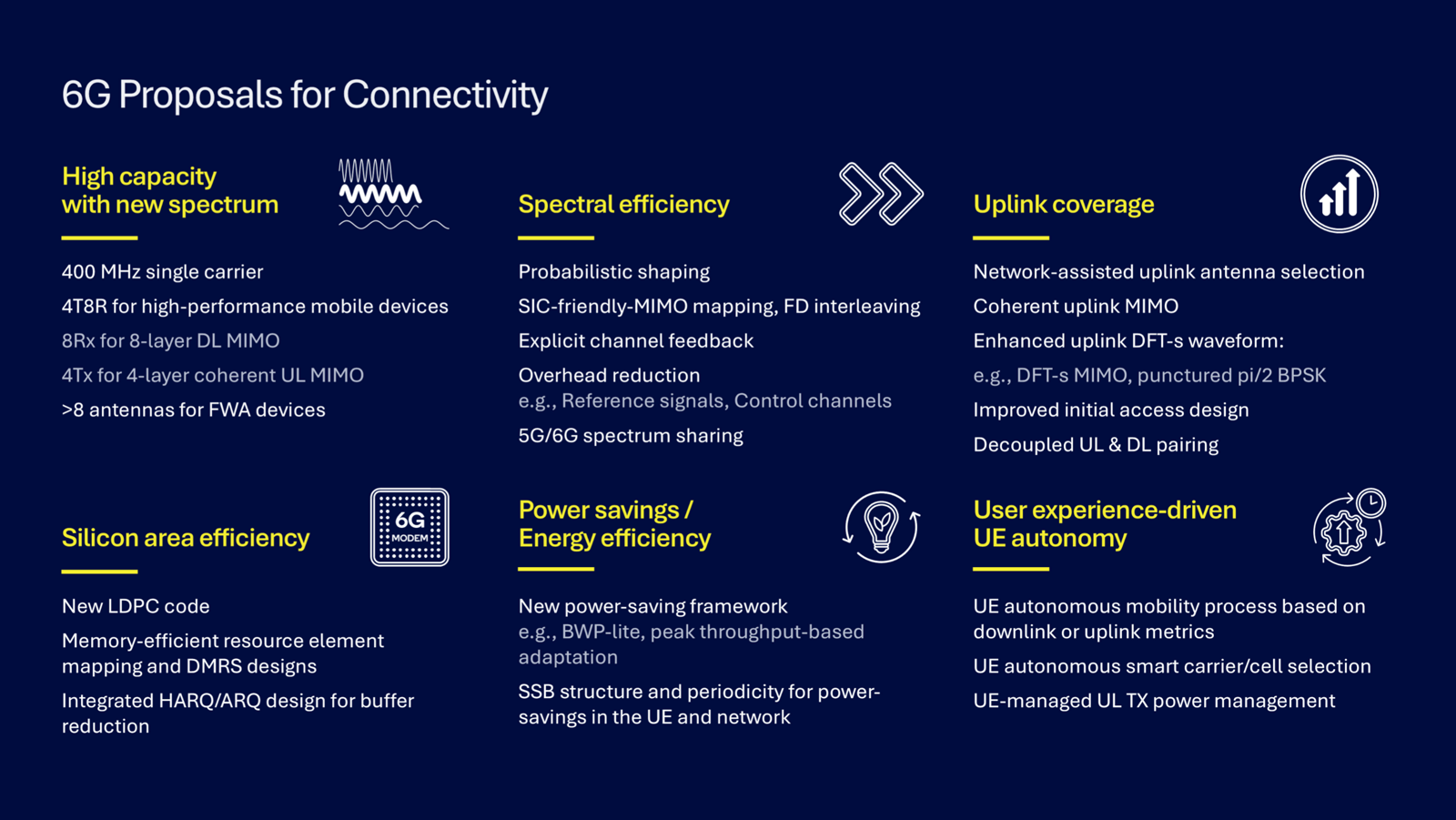
Qualcomm is outlining a different priority list for 6G. In a May 28, 2026 article on its OnQ blog, the chipmaker argues that the next generation of mobile networks should be built around coverage, uplink performance, spectral efficiency and lower power consumption—not just faster downloads.
That distinction matters because the most demanding mobile experiences are changing. Traditional smartphone traffic is often download-heavy: people open an app, request content and receive it. Qualcomm expects future AI agents, sensing-enabled devices and immersive services to create more continuous traffic in the opposite direction, with phones and other endpoints repeatedly sending context, audio, video and sensor data to nearby computing resources.
The article is a Qualcomm technology outlook rather than a ratified 6G specification. Formal specifications are expected later this decade, while Qualcomm places pre-commercial validation after that work and early commercial introductions around 2030. The timetable will vary by operator and market, so the proposals should be read as a view of the design debate, not a promise about a particular handset or network.
Why 6G may need better uplinks
For smartphone users, uplink quality increasingly determines whether an experience feels immediate. Live video, multiplayer gaming, real-time translation, collaborative editing and camera-based AI all depend on a phone sending information reliably, not simply downloading a large file quickly.
Qualcomm’s proposal therefore gives the uplink a more central role. The accompanying technical diagram highlights network-assisted antenna selection, coherent uplink MIMO, improved waveforms and a more flexible relationship between uplink and downlink resources. It also presents a 400 MHz single-carrier concept and larger antenna configurations as possible tools for improving capacity and efficiency, although those ideas remain part of the company’s proposed architecture.
The practical goal is consistency at the edge of a cell and during movement. A phone that can maintain a stable uplink is better suited to sending a live camera feed, participating in a voice conversation with cloud assistance or sharing sensor data with an AI service. That does not automatically mean every 6G device will deliver a specific speed; performance will still depend on spectrum, network deployment, device design and local conditions.
A network that understands the application
Qualcomm also describes 6G as an AI-native system spanning the device, radio access network, core, edge and cloud. In this model, a smartphone could infer what kind of traffic an application is generating and communicate relevant context to the network. The network could then adjust scheduling, quality of service and protocol behavior to match the task.
The important safeguard is that this autonomy would operate within network-defined limits. Qualcomm’s examples include smarter carrier or cell selection, mobility decisions based on live user-experience metrics and device-managed transmit-power control. In principle, that could help a phone preserve battery life during ordinary browsing while seeking more consistent resources for a latency-sensitive call or interactive AI session.
This is different from allowing an app to control the network directly. The proposed system still depends on standardized interfaces and operator policies. It would require coordination between handset vendors, chipset makers, application developers and network operators, as well as clear rules about what information devices can share.
Compute could move between the phone and the network
Another part of Qualcomm’s outlook is distributed computing. Instead of assuming that every AI task belongs either entirely on the phone or entirely in a distant data center, a 6G system could move workloads between the handset, a nearby edge site and the cloud.
When the connection is strong, a phone might offload demanding rendering or inference to obtain a larger model or richer experience. If coverage weakens or latency rises, the workload could shift back toward on-device processing to keep the interface responsive. That approach could be useful for translation, augmented reality, accessibility tools and camera features, but it also introduces engineering and privacy questions. Developers would need to decide which data can leave the handset, how models remain synchronized and what happens when the network is unavailable.
Qualcomm extends the idea to groups of personal devices. A smartphone, watch, glasses or other companion device could cooperate instead of acting as isolated endpoints. The company argues that this could compensate for the limited antennas, battery capacity or thermal headroom of smaller wearables. It is a plausible direction, but the user experience will depend on reliable handoff, compatible platforms and transparent controls.
6G is also being framed as a sensing platform
Beyond communications, Qualcomm says future radio systems could support wide-area sensing. Existing cellular infrastructure might help detect movement, vehicles or drones, creating data that can feed digital twins and industrial or public-sector applications. This would extend the value of a mobile network beyond carrying data, but it would also make governance, consent and data retention central design issues.
For smartphone owners, the immediate takeaway is more modest. Nothing in Qualcomm’s article changes what a current 5G phone can do, and the proposals still need industry-wide standardization, testing and deployment. The significance is that future mobile design is being discussed less as a race for peak download figures and more as a balance between dependable uplinks, battery life, intelligent devices and application-aware networks.
If that direction survives the standards process, the next major shift in mobile connectivity may be felt not in a single benchmark, but in how naturally phones, apps and networks share responsibility for keeping AI-powered experiences responsive.