
Actualité
Samsung’s New Galaxy Z Camera Showcase Puts Foldable Workflows in Focus
Samsung’s latest Newsroom report uses London scenes to show how the Galaxy Z Fold8 Ultra, Fold8 and Flip8 approach mobile photography and video from different angles.
Samsung is putting the camera experience of its latest foldables under the spotlight with a new Samsung Newsroom report from London. Instead of presenting the Galaxy Z Fold8 Ultra, Galaxy Z Fold8 and Galaxy Z Flip8 only as hardware updates, the company frames them as three different tools for capturing, reviewing and sharing content on the move.
The report is an official showcase rather than an independent review or laboratory test. Samsung’s examples demonstrate how the devices were used in specific London locations, while the company’s own claims should not be confused with results from an impartial test. Even with that distinction, the examples provide a useful look at where foldable designs are heading as smartphone makers combine larger screens, flexible shooting positions and increasingly automated image processing.
Three devices, three approaches to mobile imaging
The Galaxy Z Fold8 Ultra receives the most attention in Samsung’s long-distance and low-light examples. At Westminster, Samsung used the phone’s 200MP main camera to photograph Big Ben and then crop into the image by more than 10 times. The company says the camera’s HDR processing in 200MP mode is designed to retain richer colour and fine detail, including architectural features that would normally become difficult to distinguish after cropping.
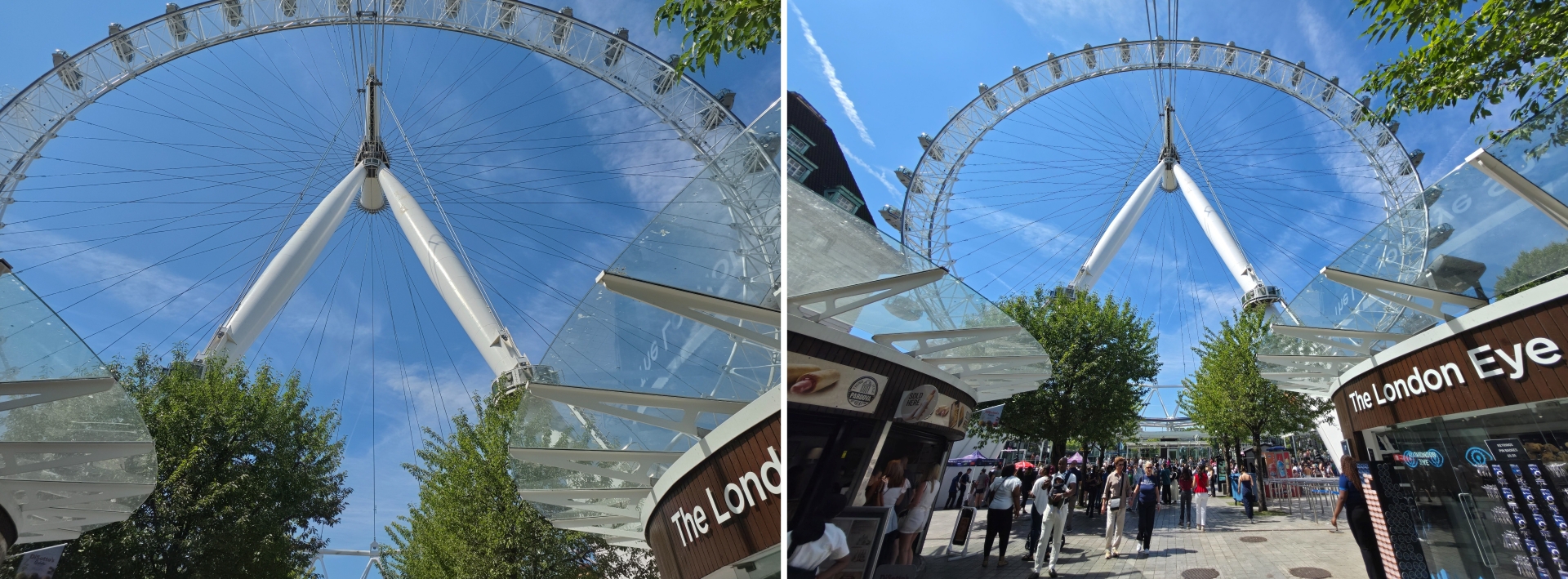
Samsung also highlights the Fold series’ first 50MP ultra-wide camera on the Fold8 Ultra. The example comes from the London Eye, where a wider field of view helps place the landmark, its ticket office and nearby visitors into one frame. That matters because foldable phones are increasingly being positioned as travel and creator devices: a wide composition can reduce the need to step back, while the large inner display provides more room to inspect the result.
The company’s night-time examples focus on Tower Bridge. Samsung says enhanced Nightography reduces noise in low-light scenes while preserving the illuminated structure and the texture of the River Thames. Those are familiar challenges for smartphone cameras, but the showcase makes the wider point that computational photography is now as important to the user experience as the camera hardware itself. The processing has to balance bright lights, dark water and moving subjects without forcing users to adjust a long list of settings.
Fold8 focuses on recording the moment and the reaction
The standard Galaxy Z Fold8 is presented less as a long-range photography tool and more as a flexible video workstation. Samsung used the phone’s Dual Recording mode while filming Tower Bridge as it opened, capturing the landmark and the reactions of the people watching it in one split-screen video.
Dual Recording uses the front and rear cameras at the same time. The main display provides a real-time preview, allowing the person filming to frame both perspectives before recording. For vloggers, event coverage and travel clips, this approach removes a common editing step: the creator does not have to record the scene first and then film a separate reaction shot.
Samsung also demonstrates Super Steady with Horizontal Lock while following a fast-moving pelican in St. James’s Park. According to the company, the feature keeps footage level even when the phone moves sharply from side to side. The feature is particularly relevant to foldable phones because their larger screens can make video review and editing more comfortable, while the device remains small enough to carry during a day outside.
After recording, the Fold8’s 7.6-inch main display can be used to review clips, adjust their aspect ratio and prepare them for sharing. That workflow is one of the clearest reasons to choose a foldable over a conventional slab phone: the device can serve as both camera and compact editing surface without requiring a second screen.
Flip8 makes positioning part of the camera experience
The Galaxy Z Flip8 takes a different approach. Samsung uses Flex Mode to show how the phone can stand at several angles for hands-free photographs and videos. The cover display acts as a live preview for selfies, which can make framing easier without opening the device.
For moving footage, the phone’s Camcorder Grip lets users hold the partially folded device more like a small camcorder. Samsung pairs that grip with a Zoom Rocker intended to make zoom changes smoother and more controlled. The company also points to a 50MP wide-angle camera and an AI-powered ProVisual Engine for detailed selfies, as well as an AI Bokeh feature that separates people from the background in portrait shots.
The broader message is that foldables are no longer being defined only by screen size. Samsung’s London showcase presents the Fold8 Ultra as a camera built around detail and reach, the Fold8 as a creator-oriented device with a larger editing canvas, and the Flip8 as a pocketable camera that changes how the phone can be positioned. Those distinctions are more meaningful than a simple specification comparison because they describe how each form factor fits into everyday shooting.
For buyers, the report also underlines an important limitation: Samsung’s examples are curated demonstrations in selected conditions, not a guarantee of identical results in every scene. Lighting, movement, subject distance and software availability can all affect the final image or video. Still, the showcase illustrates the direction of mobile photography in 2026: more processing handled automatically, more ways to capture two viewpoints at once and more emphasis on turning the phone itself into a complete content-creation workflow.