
Actualité
Viasat and BMW demonstrate satellite voice calling in a connected car
Viasat says it has integrated satellite voice calling into a BMW iX3, showing how non-terrestrial networks could extend critical communications beyond cellular coverage.
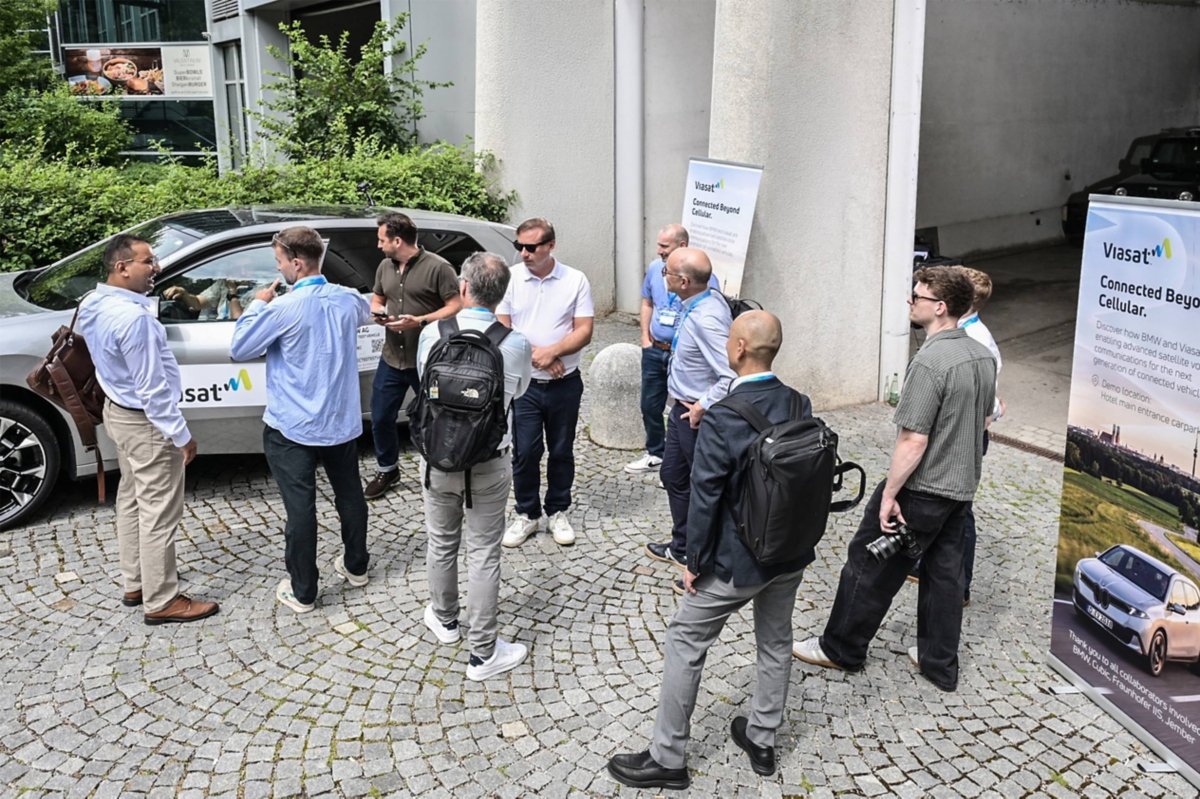
Satellite connectivity is moving beyond emergency messaging and standalone terminals. Viasat says it has demonstrated a satellite voice call fully integrated into a BMW Group vehicle, with the call initiated and managed through the car’s own infotainment interface. The result is an important proof of concept for connected mobility, but it is not a consumer product launch.
What Viasat and BMW demonstrated
During a 5G Automotive Association meeting in Munich, Viasat used a BMW iX3 to show how voice communications could continue when a vehicle is outside the reach of terrestrial mobile networks. The company describes the demonstration as the first automotive satellite voice call fully integrated into a BMW Group vehicle platform.
The distinction between an integrated demonstration and a commercial service matters. Drivers did not need to operate a separate satellite phone in the scenario described by Viasat. Instead, the vehicle’s interface was used to initiate and manage the call. That approach points toward satellite connectivity becoming another network layer for connected vehicles rather than a separate experience that drivers must learn.
Viasat’s official announcement says the technology was integrated with BMW Group’s in-vehicle architecture. It does not announce a retail launch, a supported-vehicle list, pricing, or a timetable for customer availability.
The technology behind the call
The demonstration used Viasat’s L-band satellite network and the NB-IoT communications protocol. Viasat also identifies Qualcomm Technologies’ Snapdragon Auto 5G Modem-RF Gen 2 solution and the NESC AI voice codec from Fraunhofer IIS as components of the setup.
NB-IoT is designed for efficient communications over constrained links, so using it for a voice demonstration is significant. It suggests that satellite-enabled calling could build on standards and components already associated with connected devices instead of requiring a completely separate communications stack. However, Viasat did not publish independent measurements for call quality, latency, reliability, power consumption, or handover performance. Those questions remain open until a service is tested under operational conditions.
The company says the work builds on an earlier demonstration involving Cubic³ and eSIM capabilities. In a future deployment, that type of connectivity management could help a vehicle move between terrestrial and satellite networks, but the announcement does not claim that a commercial handover service is already available.
Why this matters for mobile connectivity
For smartphone users, network availability is usually understood as a choice between mobile coverage and Wi-Fi. Connected vehicles make that model more complicated. A car can remain in motion after leaving a terrestrial coverage area, travel through sparsely populated regions, or encounter an outage after severe weather. A satellite layer could provide an additional path for selected communications when conventional coverage is unavailable.
Viasat highlights voice and messaging, emergency assistance, fleet management, and over-the-air updates as potential applications. The GSMA’s official account of the demonstration also describes future 5G New Radio-based services as part of the broader direction being explored.
Emergency communication is the clearest use case. A driver may not need full broadband access to request help, share a short message, or transmit essential status information. Fleet operators could also benefit from keeping vehicles connected across rural routes or during temporary terrestrial outages. For automakers, the attraction is continuity: a vehicle’s safety and service features would have another route to the network when the usual one fails.
That does not mean satellite connectivity will replace mobile networks. Satellite links have different capacity, latency, spectrum, terminal, and regulatory constraints. The most practical model is likely to be complementary, with terrestrial networks handling normal traffic and satellite connectivity supporting selected services in areas where coverage is limited.
What the announcement does not prove
The demonstration should not be read as evidence that BMW owners can place satellite calls today. Viasat presents the work as a technology demonstration and uses forward-looking language when discussing commercialization, future capabilities, and wider automotive adoption.
Several details needed for a real service are still missing. The announcement does not specify which additional BMW models could support the technology, whether an operator partnership would be required, which countries might receive service, or how emergency calling would be regulated. It also does not disclose the commercial relationship between the vehicle maker, satellite provider, chipset supplier, and mobile ecosystem.
Performance evidence will be just as important as integration. A production service would need to demonstrate predictable call setup, understandable audio, resilience during vehicle movement, safe operation through the existing interface, and a clear transition between cellular and satellite coverage. It would also need transparent information about where satellite connectivity works and which functions remain unavailable.
A credible step, with the hard work still ahead
Viasat and BMW have shown that satellite voice calling can be connected to a modern vehicle interface using a standards-based technology stack. That is a meaningful step for mobile and automotive communications because it moves the concept closer to an ordinary user experience.
The next milestone will not be another showcase alone. It will be a documented service with defined coverage, compatible hardware, emergency procedures, regulatory approvals, and measured performance. Until those details are published, the BMW iX3 demonstration is best understood as evidence that satellite voice could become part of the connected-vehicle network mix—not as proof that the service is ready for everyday drivers.